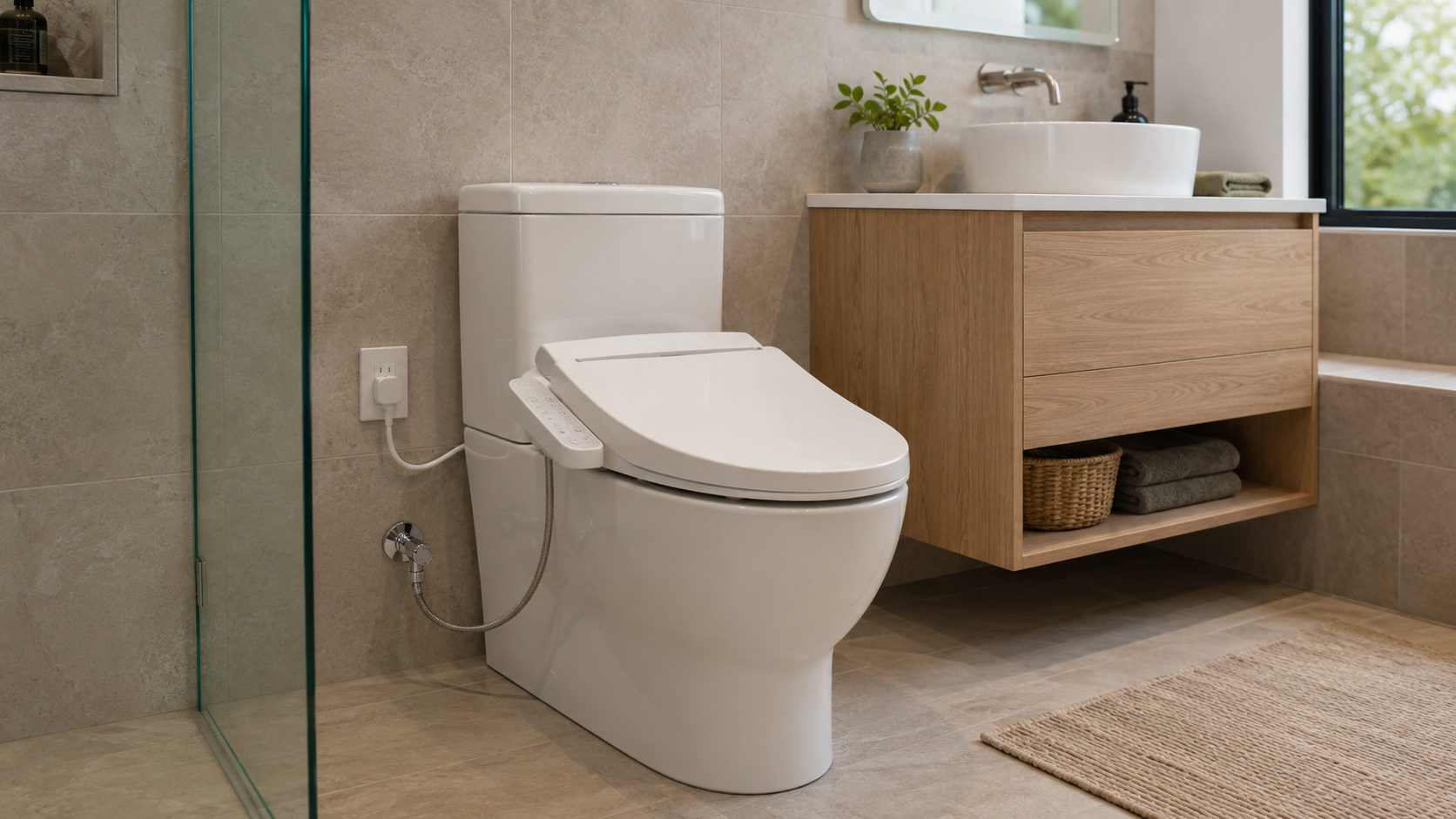
Let me be honest: fitting a smart bidet seat can look like a simple job.
Remove the existing toilet seat. Disconnect the toilet supply hose. Add a tee fitting. Connect the new seat. Plug it in.
Mechanically, some products are straightforward. But in New Zealand, the difficult part is rarely the plastic seat or the mounting bolts. The real difficulty is making sure the water connection, backflow protection, electrical supply and product evidence are appropriate for the property and the proposed installation.
A bidet seat can fit the toilet perfectly and still be unsuitable for a compliant New Zealand installation.
The most important advice in this article is simple:
Do not buy a smart bidet seat until a licensed plumber has reviewed the exact product model, the proposed connection and the available compliance information.
This guide explains what homeowners should check before ordering a bidet seat, washlet-style toilet seat or electrically heated bidet attachment in New Zealand.
Key New Zealand Compliance Numbers
Before getting into the detail, these are four current figures worth knowing:
50°C
Under the current G12/AS1 pathway, hot water delivered to new residential personal-hygiene fixtures, including bidets, must generally not exceed 50°C where the fixture was installed on or after 2 November 2024.
Official guidance:
https://www.building.govt.nz/building-code-compliance/g-services-and-facilities/g12-water-supplies/preventing-scalding-from-tap-water
0.25%
From 2 May 2026, the current G12/AS1 Acceptable Solution limits the lead content of relevant copper-alloy products in contact with drinking water to no more than 0.25%.
Official guidance:
https://www.building.govt.nz/building-code-compliance/g-services-and-facilities/g12-water-supplies/lead-in-plumbing-products
2 May 2026
From this date, G12/AS1 Amendment 14 became the only current MBIE Acceptable Solution for Clause G12. It includes the updated lead-free and dezincification-resistant copper-alloy requirements.
54 recognition notices
On 9 February 2026, MBIE published a second group of 54 recognition notices for selected plumbing and drainage products certified under the Australian WaterMark scheme.
Official update:
https://codehub.building.govt.nz/latest-updates/building-codehub-recognition-of-watermark-certified-products
These numbers do not decide whether a particular bidet seat is suitable. They show why product selection now needs more than a quick look at an online listing.
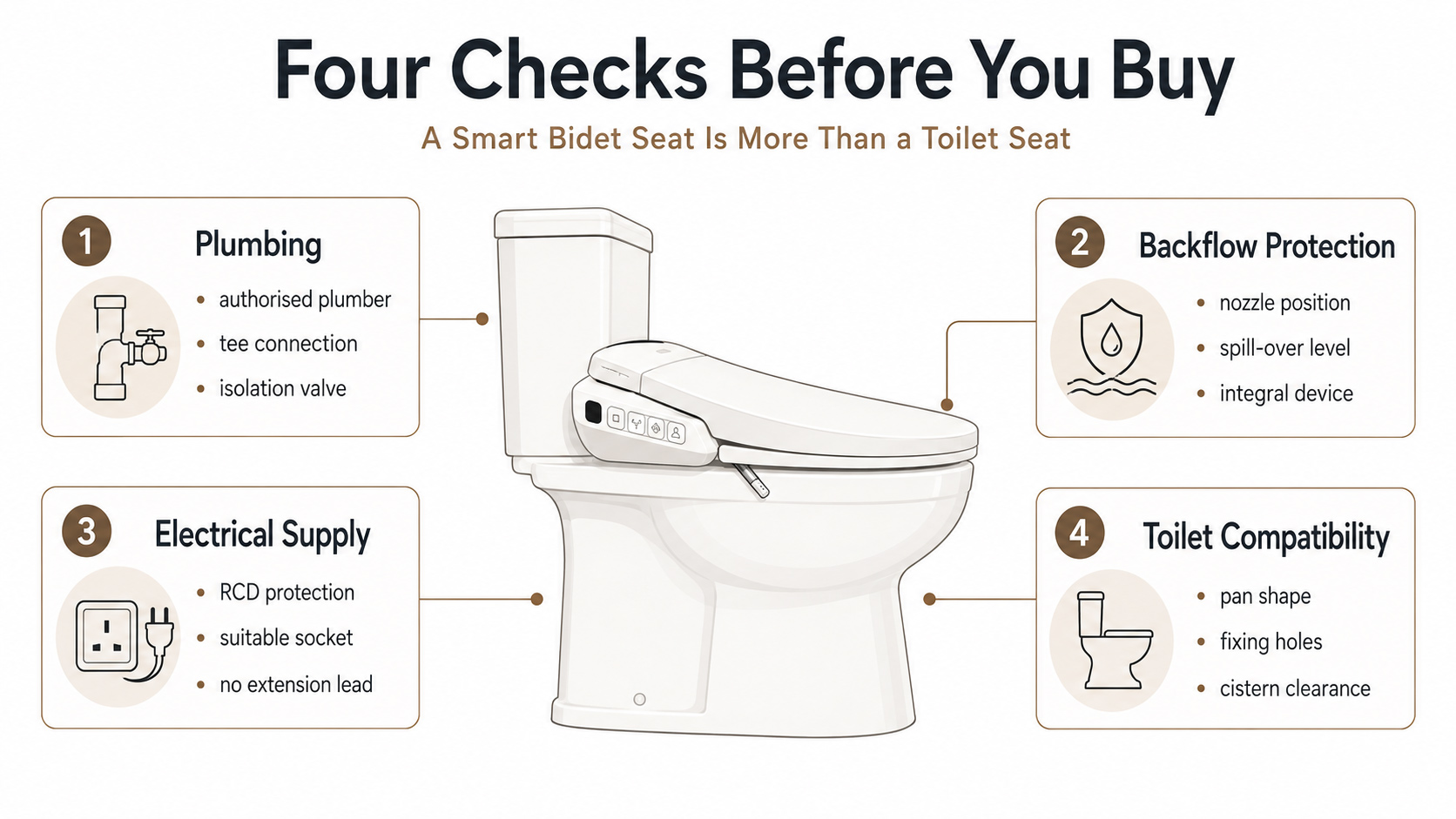
1. A Smart Bidet Seat Can Involve Three Different Compliance Systems
A smart bidet installation may involve three separate areas:
Building and plumbing compliance
Protection of the drinking-water supply
Electrical safety in a bathroom
These issues overlap, but they are not interchangeable.
A project may be exempt from needing a Building Consent while still requiring an authorised plumber. A product may have an overseas certification mark while still needing site-specific backflow assessment. An existing power outlet may work electrically while still being unsuitable for the bathroom layout or the appliance instructions.
This is why asking only:
“Do I need Council consent?”
is not enough.
The better questions are:
Does the proposed work need a Building Consent?
Who is legally authorised to carry out the water connection?
What backflow protection does this exact product require?
Is the product supported by evidence that applies to this model?
Is the existing electrical outlet appropriate?
Does the toilet shape and available space suit the seat?
Will the installation remain accessible for future servicing?
2. Does Installing a Bidet Seat Require a Building Consent?
In many existing homes, altering existing sanitary plumbing may be exempt from Building Consent when the work does not increase the total number of sanitary fixtures and does not modify or affect a specified system.
MBIE’s current guidance specifically says that an authorised person may alter existing sanitary plumbing without Building Consent where:
the total number of sanitary fixtures is not increased; and
the alteration does not modify or affect a specified system.
MBIE also lists the replacement or repositioning of an existing bath, bidet, basin, shower or toilet pan within an existing residential bathroom as an example of work that can fall within the exemption.
For a seat fitted to an existing toilet, Building Consent may therefore not be required where:
the existing toilet remains the sanitary fixture;
no new toilet, bidet or other fixture is added;
no new drainage connection is created;
no structural element is affected;
no specified system is modified;
no fire separation is penetrated;
the work is completed by an authorised plumber.
But this is not a blanket exemption for every home or every product.
Consent advice becomes more important where the project involves:
a new standalone bidet;
relocation of the toilet;
new supply or drainage points;
alterations to a multi-level apartment;
penetrations through a fire-rated wall or floor;
shared building services;
a testable backflow device that may form part of a specified system;
commercial or non-residential premises.
MBIE gives a specific example of an apartment alteration requiring consent where new plumbing penetrations pass through a fire separation. It also notes that installing a new testable backflow prevention device in a building other than a dwelling can require Building Consent and an amendment to the compliance schedule.
The important distinction
Exempt from Building Consent does not mean exempt from the Building Code.
All exempt work must still comply with the New Zealand Building Code. The owner also remains responsible for determining whether the exemption applies.
3. Can You Connect the Bidet Water Supply Yourself?
This is where many overseas installation videos become misleading.
The physical steps may look easy:
turn off the toilet isolation valve;
disconnect the existing supply hose;
install a tee connector;
attach another hose to the bidet seat.
However, the Plumbers, Gasfitters, and Drainlayers Board says homeowners cannot generally carry out work involving the fixing or unfixing of:
water-supply pipes;
plumbing fixtures or appliances;
traps;
waste pipes;
soil pipes;
ventilation pipes;
overflow pipes.
The Board states that sanitary plumbing is restricted work and that anyone carrying it out must be properly authorised.
Official consumer guidance:
https://www.pgdb.co.nz/advice_for_consumers/
MBIE also states that plumbing work completed under the Building Consent exemptions must be done by an authorised person. Its current summary lists “Authorised Plumber” as the legally required professional for alterations to existing sanitary plumbing.
Do not rely on retrospective sign-off
It is not a sound plan to install the tee valve yourself and then ask a plumber to “sign it off”.
A plumber accepting responsibility for the work needs to know:
what fittings were used;
whether the water connection is suitable;
whether the backflow arrangement is correct;
whether the installation instructions were followed;
whether the fittings meet current material requirements;
whether the pipework can be tested;
whether future servicing remains possible.
A quick visual inspection after the work is complete does not necessarily allow the plumber to verify all of this.
The safer process is:
provide the exact product information to a licensed plumber;
ask the plumber to assess the water and backflow requirements;
have the authorised practitioner complete or supervise the restricted plumbing work.
You can check a plumber’s current licence and registration status through the PGDB public register:
https://www.pgdb.co.nz/advice_for_consumers/search_the_register/
4. Backflow Protection Is the Central Plumbing Issue
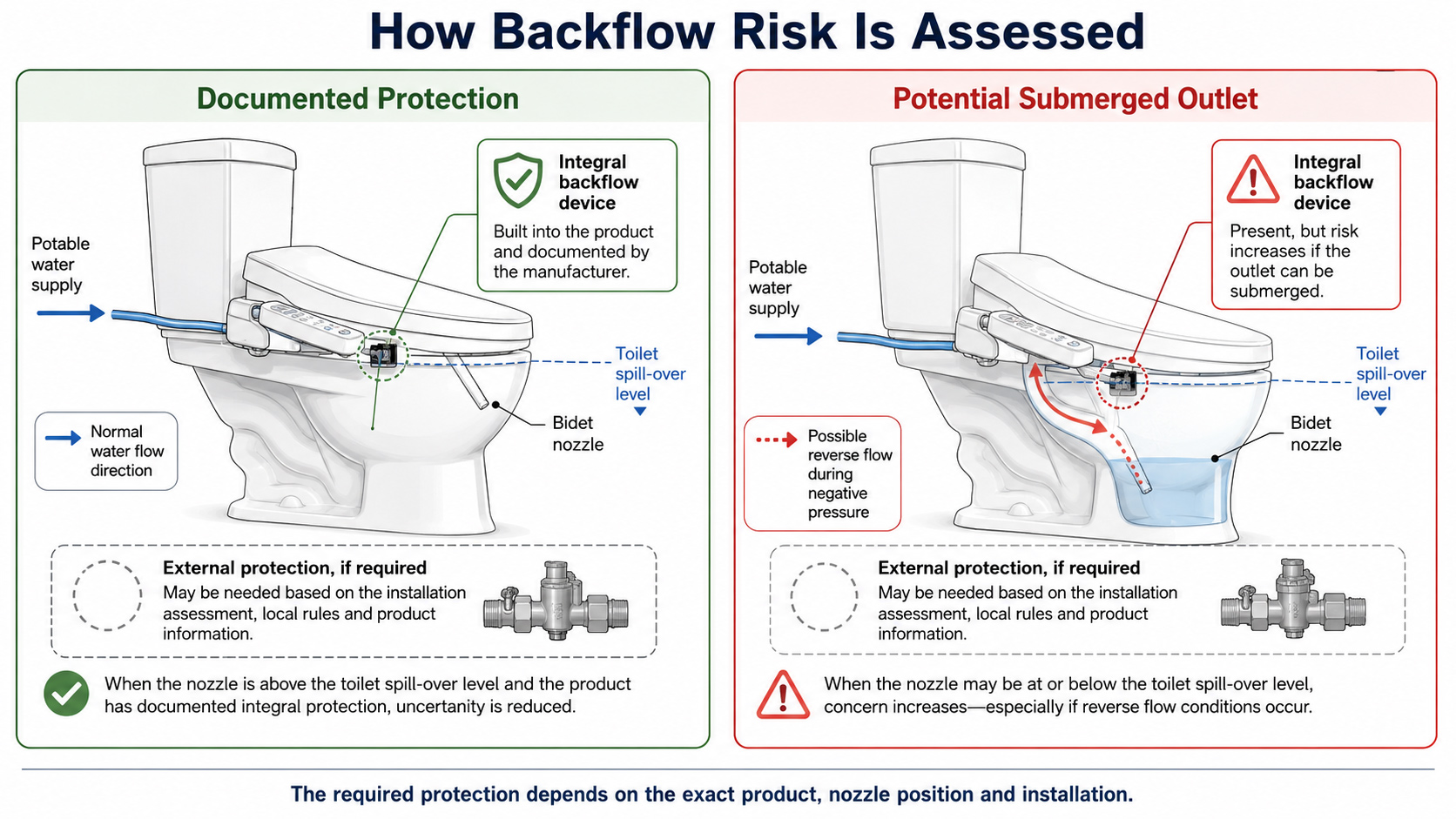
A bidet seat creates a water outlet close to a toilet bowl and to areas that may contain faecal organisms.
This creates a potential cross-connection between the drinking-water supply and a source of contamination.
Backflow generally occurs in two ways.
Back-siphonage
A pressure drop in the public main or the building supply creates suction, drawing downstream water back towards the drinking-water system.
Backpressure
The pressure on the downstream side becomes higher than the incoming supply pressure and pushes water backwards.
Watercare identifies these as the two main causes of backflow and explains that the appropriate protection depends on the degree of risk.
Official Watercare explanation:
https://www.watercare.co.nz/home/about-us/what-we-do/water-collection-treatment-and-monitoring/backflow
For a bidet seat, the plumber therefore needs to review more than the tee connector.
The assessment may include:
the position of the spray outlet;
the relationship between the nozzle and the toilet’s spill-over level;
whether the nozzle can become submerged;
whether the nozzle retracts;
how the nozzle is cleaned;
whether the product contains an integral air gap;
whether it contains an integral backflow device;
what standard that device was tested against;
whether supplementary backflow protection is required;
whether any testable device can be accessed and maintained.
AS/NZS 3500.1 includes a dedicated section for the water supply to bidets, bidettes and toilet-seat douche fittings.
Official CodeHub resource:
https://codehub.building.govt.nz/resources/asnzs-3500-12015
The public CodeHub page confirms that Section 12.2 specifically covers:
Bidet, Bidette and Toilet Seat Douche
This is one reason generic online statements such as “the seat already has a check valve” are not enough. The complete installation must be assessed.
5. Does Every Bidet Seat Require an RPZ Device?
No responsible article should say that every smart bidet seat automatically requires the same external RPZ device.
A reduced pressure zone device, commonly called an RPZ or RPZD, is one type of testable backflow prevention device. It is used for certain higher-risk arrangements, but the appropriate protection depends on the exact product and installation.
Relevant factors can include:
the hazard classification;
whether the outlet may become submerged;
nozzle height;
spill-over level;
the integral protection built into the seat;
the standard used to test that protection;
the installation instructions;
the building type;
local network requirements;
whether a testable device can be maintained.
Watercare lists both reduced pressure zone devices and double-check valves as examples and says the selected type depends on the degree of risk.
That means neither of these statements is reliable without a product assessment:
“Every bidet seat needs an RPZ.”
“This seat has a check valve, so no other protection is needed.”
The correct question is:
What backflow protection is required for this exact product, installed on this exact toilet, in this exact property?
That decision should be made by an authorised plumber using the product evidence and applicable compliance pathway.
6. Why Some Cheap Imported Attachments Become Difficult to Install
Many low-cost bidet attachments are sold with only:
a plastic tee connector;
a flexible hose;
a shut-off valve;
an exposed or retractable nozzle;
a short instruction sheet.
The listing may use phrases such as:
anti-backflow;
hygienic design;
certified quality;
universal fit;
suitable for all toilets.
These phrases are not compliance evidence.
A plumber may still need to know:
which device prevents reverse flow;
what standard it was tested against;
what hazard level it is suitable for;
whether the certificate applies to the exact model;
whether the supplied hose and valve are approved for potable water;
whether the fittings suit New Zealand pressure and thread requirements;
whether the nozzle arrangement matches the certification.
A product is not necessarily unlawful simply because it was imported. The practical problem is that some products arrive with too little verifiable information to support a compliant installation.
A low purchase price can therefore create an expensive planning problem if the necessary external protection, fittings or replacement product are identified only after purchase.
7. What WaterMark Means in New Zealand
WaterMark is an Australian plumbing-product certification scheme.
A valid WaterMark certificate can provide useful evidence that a product has been evaluated against a nominated standard. In New Zealand, MBIE now recognises selected WaterMark-certified product categories through formal overseas-product recognition notices.
On 9 February 2026, MBIE published a second group of 54 recognition notices. These notices confirm that selected plumbing and drainage products certified under WaterMark meet specified clauses of the New Zealand Building Code.
Official update:
https://codehub.building.govt.nz/latest-updates/building-codehub-recognition-of-watermark-certified-products
This is important, but it should not be misunderstood.
WaterMark is not a universal approval for every installation
A WaterMark logo does not automatically prove:
that the certificate is current;
that it covers the exact bidet model;
that all supplied fittings are covered;
that the seat suits the proposed toilet;
that its integral backflow protection is sufficient;
that no external device is required;
that the electrical side is suitable;
that the installation method complies in your building.
What to verify
Ask for:
the WaterMark licence number;
the certificate holder;
the exact model number;
the nominated standard;
the certificate validity;
the product scope;
installation limitations and conditions.
A certificate for a related valve, hose or earlier model does not necessarily cover the complete seat being offered.
A more accurate question
Do not ask only:
“Does it have WaterMark?”
Ask:
“What compliance evidence applies to this exact model, and what installation conditions must be met when it is connected to a New Zealand potable-water supply?”
8. The Tee Valve and Connectors Matter Too
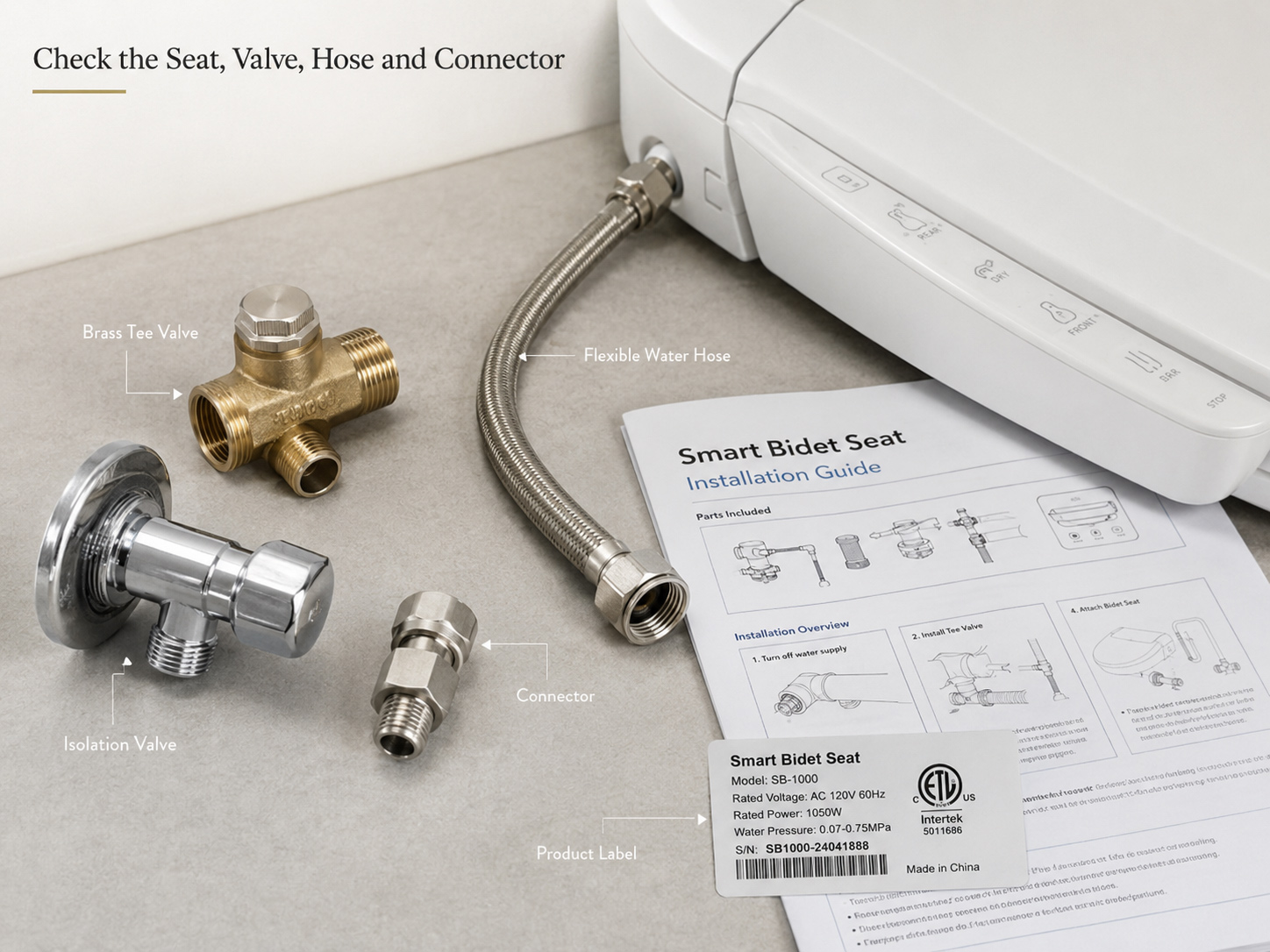
Homeowners naturally focus on the bidet seat itself. But the supplied tee valve, adaptors, isolation fittings and connectors also become part of the drinking-water system.
From 2 May 2026, G12/AS1 Amendment 14 became the only current MBIE Acceptable Solution for Clause G12.
Under that pathway:
copper-alloy products used in contact with drinking water must contain no more than 0.25% lead;
copper-alloy components in contact with drinking water and subject to hydrostatic pressure must meet the applicable dezincification-resistant, or DZR, requirements.
The products covered include:
pipe fittings;
valves;
taps;
mixers;
water heaters;
water meters.
Official guidance:
https://www.building.govt.nz/building-code-compliance/g-services-and-facilities/g12-water-supplies/lead-in-plumbing-products
This matters because a small brass tee or adaptor supplied with an imported seat may be pressure-bearing and in contact with potable water.
The fitting should not be treated as a disposable accessory outside the compliance assessment.
Ask the supplier or plumber:
What material is the valve made from?
Is the product covered by current certification?
Does it meet the relevant lead-content requirement?
Is the pressure-bearing copper alloy DZR?
Are the hoses rated for the local water pressure?
Are the threads and sealing method suitable for the installation?
9. Heated Water and the 50°C Limit
Smart bidet seats generally use one of three water arrangements:
Cold-water only
Cold water heated internally by the seat
Separate hot- and cold-water connections
Where hot water is delivered for personal hygiene, temperature control becomes part of the safety assessment.
MBIE states that, under the current G12/AS1 Acceptable Solution, the maximum hot-water delivery temperature for new personal-hygiene fixtures in residential housing is generally 50°C.
This includes bidets.
The reduction from 55°C to 50°C applies to new personal-hygiene fixtures installed on or after 2 November 2024 when the Acceptable Solutions are used as the means of compliance.
Official guidance:
https://www.building.govt.nz/building-code-compliance/g-services-and-facilities/g12-water-supplies/preventing-scalding-from-tap-water
For an internally heated seat, ask:
What is the maximum outlet temperature?
How is that temperature limited?
What happens if the temperature sensor fails?
Does the product stop heating when water flow stops?
Is there independent evidence for the heating and safety controls?
For a product connected to the building’s hot-water supply, the plumber may also need to assess:
the source temperature;
the mixing arrangement;
the temperature-limiting device;
the pipe length;
stagnation;
response time;
cold- and hot-water pressure balance.
A temperature shown on a remote-control display is not, by itself, proof of compliance.
10. Electrical Requirements for Smart Bidet Seats
A non-electric cold-water attachment may not need power.
A smart model can include:
instant water heating;
a small storage heater;
heated seating;
warm-air drying;
deodorising;
automatic opening;
pumps;
sensors;
night lighting;
electronic controls.
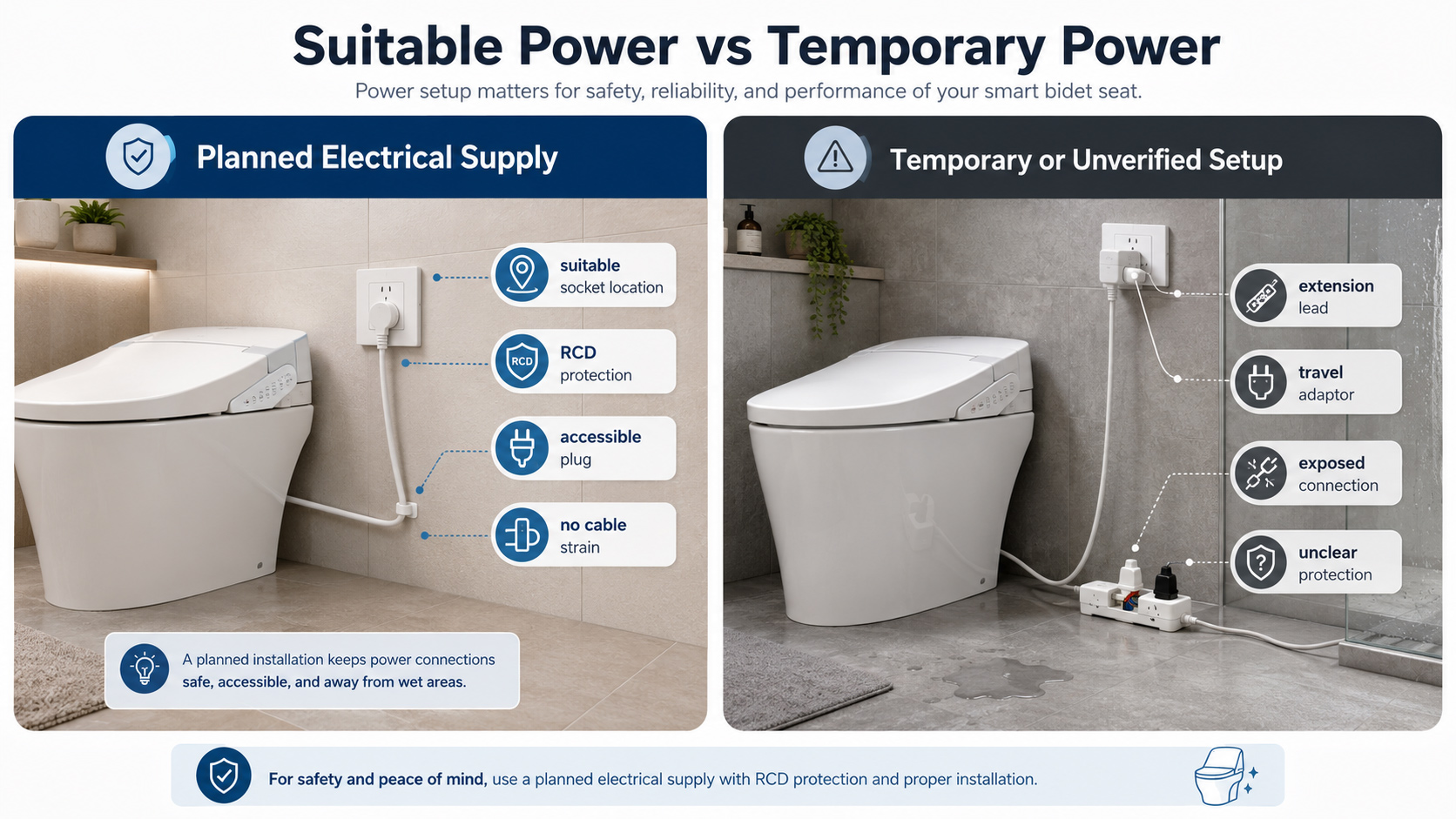
These functions require a suitable electrical supply near the toilet.
Use the New Zealand term: RCD protection
WorkSafe explains that residual current devices, or RCDs, monitor current flow and rapidly disconnect the circuit when leakage to earth is detected.
WorkSafe recommends RCD protection in damp areas such as:
bathrooms;
laundries;
kitchens;
garages;
pool areas;
external outlets.
It also states that new domestic circuits supplying lighting or socket outlets are legally required to have RCD protection.
Official guidance:
https://www.worksafe.govt.nz/managing-health-and-safety/consumers/safe-living-with-electricity/cords-and-leads/
Do not use a universal “one-metre rule”
The original product instructions may say that the outlet should be within a certain distance because the power cord is short.
That does not mean every outlet within that distance is legally suitable.
The electrician must consider:
the bathroom electrical zones;
proximity to a shower or bath;
the toilet and basin position;
the outlet type;
the IP rating, where relevant;
the appliance instructions;
RCD protection;
circuit capacity;
plug accessibility;
the cord route.
The outlet must be both reachable by the supplied cord and appropriate for the actual bathroom layout.
When an electrical worker should be involved
Professional assessment is appropriate where the project requires:
a new outlet;
relocation of an outlet;
fixed wiring;
a new circuit;
hard-wiring;
changes to the switchboard;
changes to RCD protection;
assessment of a socket in or near a bathroom zone.
New Zealand does permit homeowners to carry out limited electrical work in an owner-occupied home under specific conditions. However, the rules are detailed, and bathroom work can present additional safety issues.
For a new smart bidet outlet, the practical recommendation is to use a registered and licensed electrical worker who can assess, test and document the installation correctly.
Do not use an extension lead as the permanent supply
WorkSafe states that extension cords are intended for temporary use only. Where a permanent source of power is required, a licensed electrician should install a power socket.
An extension lead behind a toilet can also create:
water-exposure risk;
loose connections;
damaged insulation;
poor cleaning access;
a connection close to the floor;
trip hazards;
trapped or crushed cable.
The permanent solution is a suitable outlet, not a longer loose cord.
11. Check the Product’s Electrical Evidence
Before buying an electric seat, request:
rated voltage;
frequency;
maximum power demand;
maximum current;
plug type;
power-cord length;
appliance safety documentation;
IP rating, where stated;
required circuit protection;
installation clearances;
instructions for wet-area use;
New Zealand warranty and service information.
A product designed for another country may have:
a different voltage;
a different frequency;
a non-New Zealand plug;
a travel adaptor;
no local supplier support;
no acceptable declaration or supporting documentation.
Avoid products supplied with a travel adaptor as the intended permanent connection.
12. Toilet Compatibility Still Matters
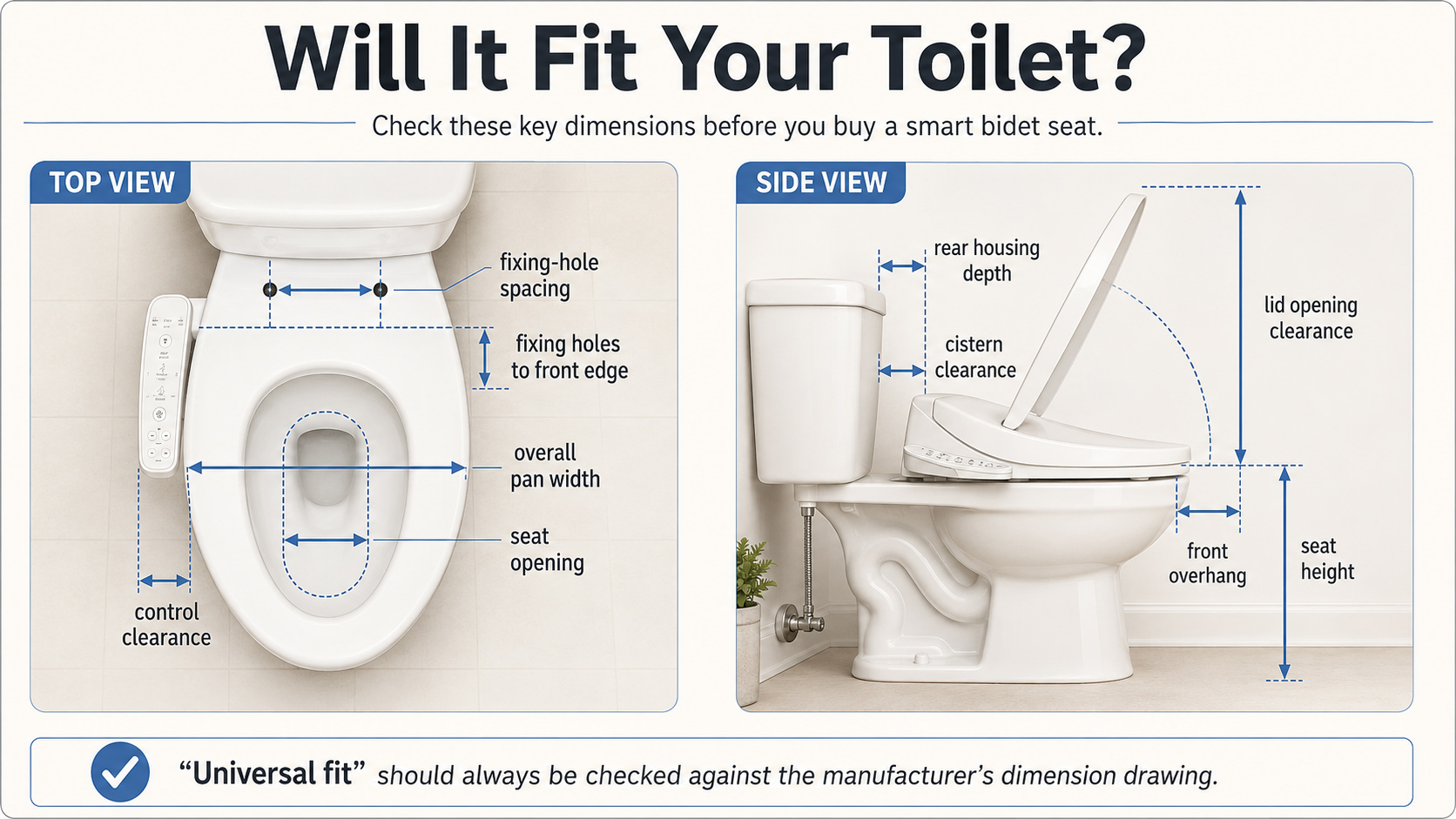
Even after the compliance issues are addressed, the seat must physically fit the toilet.
“Universal fit” should be treated as a claim to verify, not a measurement.
Pan shape
Identify whether the toilet is:
round;
elongated;
D-shaped;
square-fronted;
compact;
proprietary or integrated.
Fixing geometry
Measure:
centre-to-centre distance between the fixing holes;
distance from the fixing holes to the front of the pan;
total pan width;
available hinge space;
whether the toilet uses top-fix or concealed fixings.
Rear clearance
The electronic housing may conflict with:
the cistern;
a concealed-cistern wall;
a flush button;
a shelf;
a boxed pipe;
an unusually raised pan profile.
Water connection
Confirm:
isolation-valve location;
thread size;
existing hose type;
rigid or flexible supply;
space for the tee;
hose bend radius;
whether the valve remains operable;
whether the hose can be routed without kinking.
User and room clearance
A smart seat may be deeper or bulkier than the original seat.
Check:
front overhang;
side-wall clearance;
door movement;
cleaning space;
control-panel access;
whether the seat changes the usable opening size;
whether the lid can open fully.
Do not order solely from the toilet’s advertised width.
13. Apartments, Townhouses and Body-Corporate Properties
A bidet-seat installation in a multi-unit building can involve additional restrictions.
The alteration may interact with:
shared water risers;
common-property pipework;
central backflow protection;
fire-rated walls or floors;
acoustic systems;
body-corporate rules;
compliance schedules;
building insurance conditions;
access to isolation valves.
MBIE’s exemption guidance makes clear that work affecting a specified system, including fire separation, may require consent even where a similar alteration in an ordinary standalone dwelling might not.
Before buying, seek written confirmation from the relevant parties, which may include:
the body corporate;
property manager;
building facilities manager;
landlord;
licensed plumber;
local council.
Do not assume that an alteration inside the apartment is automatically private work. The water supply or wall being altered may form part of the shared building.
14. Ongoing Testing and Maintenance May Be Required
Some backflow devices are testable devices and may require ongoing testing.
Watercare states that a backflow prevention device protecting the water supply must be tested annually. The exact requirement depends on the device and the network or property arrangement.
Official guidance:
https://www.watercare.co.nz/home/about-us/what-we-do/water-collection-treatment-and-monitoring/backflow
Before selecting an installation that requires an external testable device, ask:
Who will test it?
How often must it be tested?
Where will it be installed?
Can it be accessed without removing the toilet?
Will it discharge water during testing or fault conditions?
Does it need drainage?
Will the result need to be reported?
Is there an annual service cost?
Does it affect a compliance schedule?
A device hidden behind fixed cabinetry is not properly serviceable simply because it was installed correctly on day one.
15. What to Ask the Supplier Before Buying
A responsible supplier should be able to provide more than a brochure.
Ask these questions in writing:
What is the exact product model number?
What plumbing standard has the product been tested against?
Is there a current WaterMark certificate for this exact model?
What is the WaterMark licence number?
What integral backflow protection is included?
What standard was the backflow arrangement tested against?
Is external backflow protection required in New Zealand?
Can you provide a section drawing showing the nozzle position?
Can you provide the nozzle and spill-over-level relationship?
What inlet-pressure range is permitted?
What is the maximum static pressure?
Which hoses, valves and adaptors are included?
Do the supplied copper-alloy fittings meet current lead-free and DZR requirements?
What is the rated voltage and frequency?
What is the maximum electrical demand?
What plug is supplied?
How long is the power cord?
Does the seat require a dedicated circuit?
What electrical safety documentation is available?
What is the New Zealand warranty?
Are replacement hoses, nozzles, filters, heaters and control modules available?
Who provides repair support in New Zealand?
A supplier who replies only with “WaterMark approved” or “NZ compatible” has not answered these questions.
16. What to Ask the Plumber
Send the product documents to the plumber before ordering.
Ask:
Is this product suitable for connection to the potable water supply?
Does the proposed work fall within a Building Consent exemption?
What hazard classification applies?
What backflow protection is required?
Is the integral protection sufficient?
Is an external device required?
Is a testable device required?
Will the device need annual testing?
Can the proposed fittings be used under the current G12 compliance pathway?
Will the existing isolation valve remain accessible?
Does the seat suit the existing water pressure?
Can all components be serviced after installation?
Is Council or body-corporate confirmation needed?
What documentation will be provided after completion?
A plumber may decline to connect a product that lacks sufficient evidence.
That is not unreasonable caution. The practitioner is responsible for the plumbing work and needs a defensible basis for accepting the product.
17. What to Ask the Electrician
For an electric model, ask:
Is the existing socket suitable for this bathroom location?
Does the circuit have appropriate RCD protection?
Is the existing circuit capacity sufficient?
Can the supplied plug remain accessible?
Does the cord reach without an extension lead?
Is a new outlet or circuit needed?
Does the product’s electrical documentation appear suitable?
Will an Electrical Safety Certificate or other applicable documentation be supplied?
Will the work affect any other bathroom fittings?
Can the outlet be isolated for servicing?
The best time to ask is before the seat is purchased, not after it has arrived.
18. A Better Installation Process
A safer project follows this order.
Step 1: Identify the exact product
Record the full model number, not just the brand or marketplace title.
Step 2: Obtain the technical documents
Collect:
plumbing certification;
WaterMark information;
installation instructions;
backflow details;
pressure limits;
electrical specifications;
dimension drawings;
warranty terms.
Step 3: Ask a licensed plumber to assess it
Do this before ordering a non-returnable product.
Step 4: Ask an electrician to assess the power supply
This is especially important if no suitable outlet already exists.
Step 5: Measure the toilet
Use the manufacturer’s dimension drawing, not a generic fit chart.
Step 6: Check consent and property restrictions
Confirm the position with Council, the body corporate or property manager where necessary.
Step 7: Obtain written quotations
Ask the quote to distinguish between:
supply of the seat;
plumbing labour;
tee and valve components;
external backflow protection;
installation and testing;
electrical outlet or circuit work;
making good;
ongoing testing.
Step 8: Keep the records
Save:
product certificates;
installer details;
invoices;
photos;
backflow information;
electrical documentation;
warranty records;
future test records.
19. Common Mistakes to Avoid
Buying before the plumber reviews the product
A low-cost seat is not good value if it cannot be connected using a practical compliance pathway.
Assuming a basic check valve resolves the backflow issue
The required protection depends on the hazard and installation, not just the presence of a valve.
Treating the WaterMark logo as the complete answer
Verify the exact certificate, model, standard and conditions.
Connecting the tee yourself
The apparent simplicity of the connection does not remove sanitary-plumbing restrictions.
Asking for retrospective sign-off
A licensed practitioner may not be able to verify or accept work completed by someone else.
Using the supplied brass fitting without checking it
The tee and adaptors are part of the potable-water installation.
Installing a travel adaptor
A foreign plug and travel adaptor are not a suitable permanent bathroom solution.
Using an extension lead
WorkSafe treats extension leads as temporary equipment.
Blocking the isolation valve
The toilet and bidet supplies need an accessible isolation method.
Ignoring annual testing
A testable backflow device may create an ongoing maintenance obligation.
Ignoring replacement parts
Electronic valves, heaters, pumps, nozzles and control modules may eventually need replacement.
20. Pre-Purchase Checklist
Product and toilet fit
□ Exact model number recorded
□ Pan shape confirmed
□ Fixing-hole spacing measured
□ Front projection checked
□ Cistern clearance checked
□ Lid and seat can open fully
□ Controls will remain accessible
□ Cleaning space is adequate
Plumbing
□ Licensed plumber has reviewed the product
□ Building Consent position has been considered
□ Water connection method is confirmed
□ Backflow hazard has been assessed
□ Integral protection has supporting evidence
□ External protection requirement is confirmed
□ Annual testing requirement is understood
□ Isolation valve remains accessible
□ Inlet pressure range is suitable
□ Supplied hoses and valves are acceptable
□ Lead-free and DZR requirements have been considered
□ Components can be serviced after installation
Electrical
□ Product is suitable for New Zealand voltage and frequency
□ New Zealand plug is supplied
□ Existing outlet has been assessed
□ Bathroom location is suitable
□ RCD protection is confirmed
□ Circuit capacity is adequate
□ Cord reaches without an extension lead
□ New electrical work has been quoted where required
□ Electrical documentation is available
Property and approvals
□ Council advice obtained where the exemption is uncertain
□ Body-corporate approval obtained where applicable
□ Shared services will not be altered without approval
□ Fire-rated walls or floors will not be affected without consent
□ Building insurance requirements have been checked
Ownership and servicing
□ New Zealand warranty confirmed
□ Local service support identified
□ Replacement parts are available
□ Product certificates have been saved
□ Plumbing records will be retained
□ Electrical records will be retained
□ Backflow-test records will be retained where applicable
Final Advice
Smart bidet seats can be comfortable, hygienic and useful. But in New Zealand, selection should begin with the water connection and compliance evidence—not with the heated seat, remote control or drying function.
Before buying:
identify the exact model;
obtain its plumbing and electrical documents;
ask a licensed plumber to assess the backflow and water connection;
ask a licensed electrical worker to assess the power arrangement where necessary;
confirm the Building Consent and property-management position;
keep the installation records.
The important distinction is not between a cheap seat and an expensive seat.
It is between:
a product that has been fitted because it physically fits, and a system that has been selected, connected and documented for safe, compliant and serviceable use in New Zealand.
Important Disclaimer
This article provides general planning information only. It is not a substitute for project-specific advice from an authorised plumber, licensed electrical worker, building consent authority, network water supplier, product certifier or body corporate.
Requirements depend on the exact product, property, installation method, compliance pathway and applicable standards at the time of the work.