
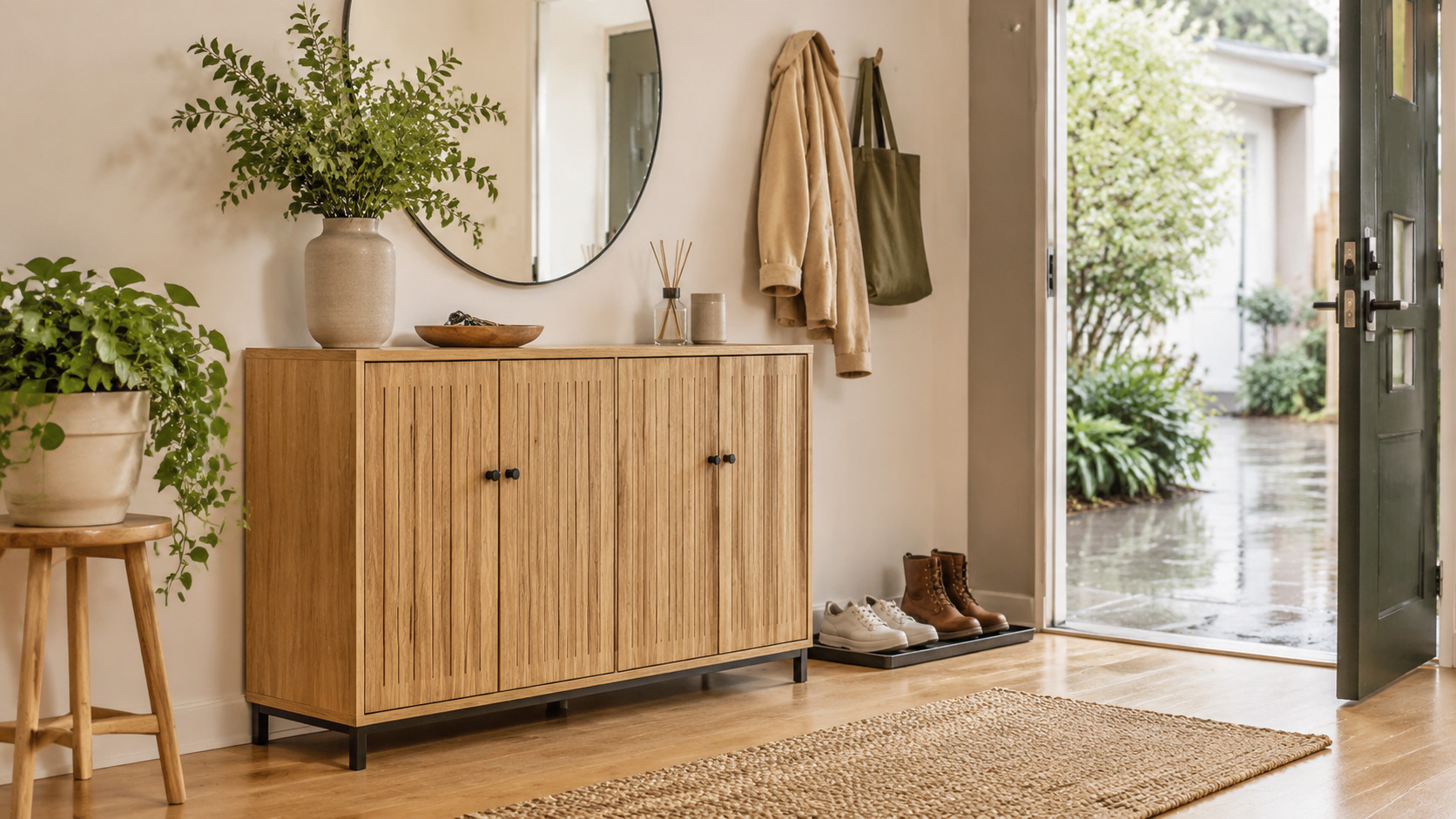
A pair of wet shoes beside the door, dust on a lower shelf and drawers opened several times a day: entryway furniture has a practical job to do. Choosing a piece that looks right is only part of the decision.
The materials affect how furniture responds to its surroundings, but they do not tell the whole story. Construction, surface finishes, storage layout and ease of maintenance all influence how well a piece works in everyday life.
For Australian homes, the best starting point is the entrance itself. This guide explores the differences between MDF, plywood, solid timber and metal, and explains what to consider when choosing furniture for your space.
Why Your Entryway Environment Matters
Australia does not have one uniform climate, and neither do its homes. A protected apartment hallway and an open coastal verandah place very different demands on furniture.
Rather than choosing a material based on its reputation, consider what the furniture will encounter during an ordinary week.
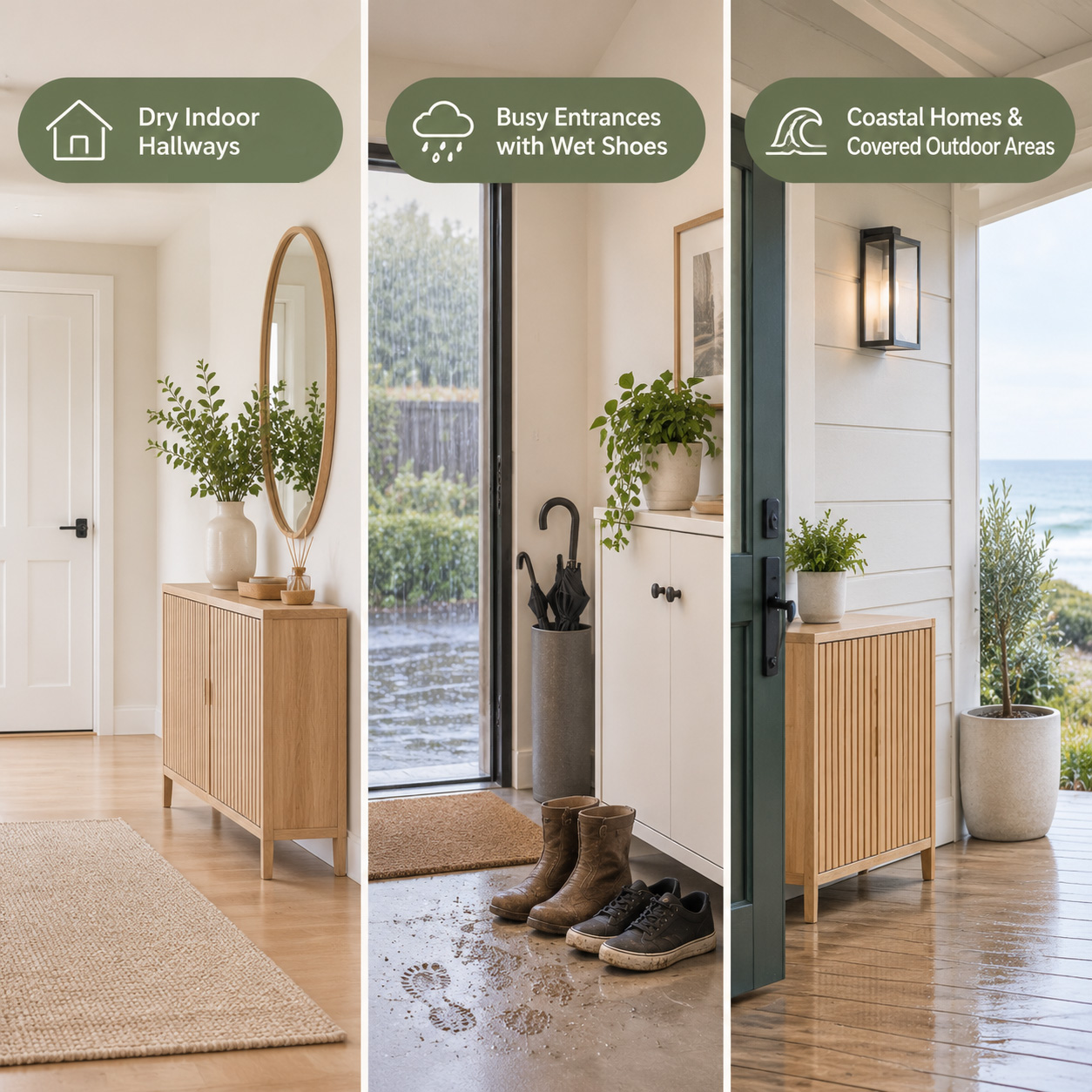
Dry indoor hallways
A fully enclosed hallway that stays dry gives you a wider range of furniture options. Everyday handling, dust and the belongings stored inside are likely to be the main considerations.
You might only need a console table for keys and mail, or a closed cabinet for shoes and bags. In this setting, focus on the function and appearance you need rather than paying for weather resistance that the location does not require.
It is also worth checking whether the wall and floor remain dry throughout the year. A spot that looks fine in summer may need closer attention if condensation appears during colder months.
Busy entrances with wet shoes
A back door, laundry entrance or garage connection may receive damp footwear more often than the front hallway. Think about where rainwater, mud and moisture end up when everyone comes home.
Humidity and direct water contact are different conditions. WoodSolutions distinguishes moisture absorbed from the air from liquid water introduced through rain, condensation or other direct exposure.
This distinction matters because furniture designed for ordinary indoor conditions may not be suitable for repeated contact with wet footwear. If damp shoes are part of your daily routine, consider a separate tray or drying area rather than placing them directly inside a closed cabinet.
Coastal homes and covered outdoor areas
In coastal homes, consider how exposed the entrance actually is. An enclosed foyer is different from a cabinet positioned beside an open door or on a verandah exposed to wind-blown salt.
For steel furniture, moisture and salt are important corrosion factors. The protective coating needs to suit the environment where the piece will be used.
A roof alone does not turn an outdoor position into an indoor one. If furniture will sit outside the enclosed home, check for explicit manufacturer approval for that type of use.
Understanding Four Common Furniture Materials
Material descriptions become easier to understand when you separate the core from the visible surface. Paint, timber veneer and decorative woodgrain finishes can cover very different materials underneath.
A single piece may also combine several components. The doors, shelves, back panel and legs do not necessarily share the same construction.
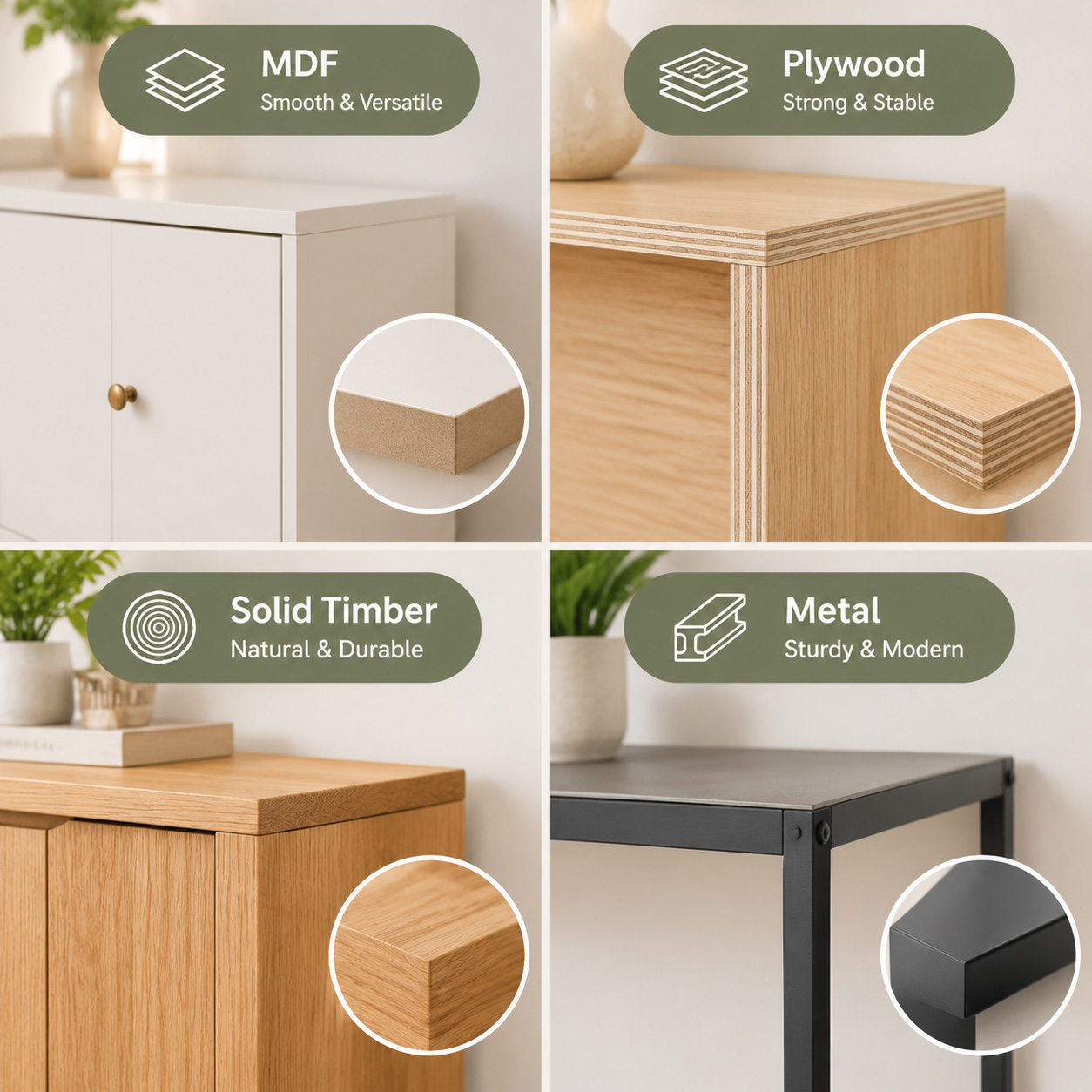
MDF: Smooth finishes and everyday indoor furniture
MDF, or medium-density fibreboard, is made from refined wood fibres pressed into dense panels. Its fine, uniform surface makes it a common base for painted joinery and decorative panels.
It is worth considering when you prefer a consistent painted appearance rather than visible natural grain. A white hallway cabinet, for example, may use MDF beneath its finish, although colour alone cannot identify the core material.
Standard MDF is generally intended for dry interiors, while moisture-resistant grades are available for specified conditions. However, moisture resistance should not be confused with waterproofing. It does not guarantee that a finished cabinet can tolerate repeated soaking.
Plywood: Layered construction and different grades
Plywood is made by bonding thin sheets of timber veneer together, usually with the grain running in alternating directions. This cross-laminated structure helps the panel remain relatively stable as temperature and moisture conditions change.
Its layered construction is a defining feature, whether the edges are visible or hidden beneath a finish. However, not all plywood products have the same properties or intended uses.
WoodSolutions identifies structural, exterior, interior and marine categories, each designed for particular applications. The term "plywood" therefore describes how a panel is made, not a complete statement about where the finished furniture can be used.
Solid timber: Natural appearance and moisture movement
Solid timber appeals to people who prefer natural grain and variation. Different species have different characteristics, so "solid wood" is a starting description rather than a complete measure of quality.
Unlike a printed woodgrain surface, natural timber will not look identical from panel to panel. Some variation is part of the material rather than a flaw in the finish.
Timber also exchanges moisture with the surrounding air, expanding or shrinking as its moisture content changes. Good furniture design needs to accommodate this natural movement; being indoors does not remove it entirely.
Metal: Frame design, coatings and corrosion
Metal furniture may have a slim supporting frame, a complete sheet-metal body or a combination of metal and timber-based panels. These designs can look similar in photographs while offering different structures and storage layouts.
The base metal matters too. Steel, aluminium and other metals should not be treated as interchangeable, and a listing that only says "metal" leaves useful information unanswered.
For ordinary steel, protective coatings help reduce corrosion by limiting contact with moisture, salts and oxygen. A coloured or powder-coated finish is not, by itself, proof that a piece is suitable for every coastal or outdoor location.
What Matters Beyond the Material
Two pieces made from the same material can perform differently because of their construction, finish and design. These details are often more useful than the material name alone when comparing furniture.
Construction and shelf support
Look at how each shelf is supported, especially across wider sections. A long, uninterrupted span deserves closer attention than a short compartment supported on both sides.
Use the manufacturer's stated load rating rather than estimating strength from thickness or weight alone. Terms such as "solid timber" and "steel" do not tell you how much a particular shelf is designed to carry.
Doors and drawers should also suit the way the furniture will be used. For pieces that will be opened frequently, check the hardware details and whether replacement parts are available.
If the furniture doubles as a seat, confirm that it is specifically designed for sitting. The permitted load on a storage bench is separate from the load allowed on its shelves.
Surface finishes and edge protection
The finish is the part that comes into contact with shoes, bags, keys and cleaning cloths. It influences everyday care even when the material underneath remains unchanged.
Paint, veneer, laminate and clear coatings are different finishes. Veneer is a thin layer of real wood applied over a base material, while a decorative woodgrain surface can reproduce the appearance of timber without using a natural wood face.
Pay attention to panel edges, corners and joints as well as the main surfaces. Ask how these areas are protected rather than assuming an attractive front means every part has the same treatment.
Interior timber coatings can help with cleaning and resistance to staining, but they should be viewed as part of a protection system rather than a guarantee that furniture is damage-proof.
Ventilation and moisture management
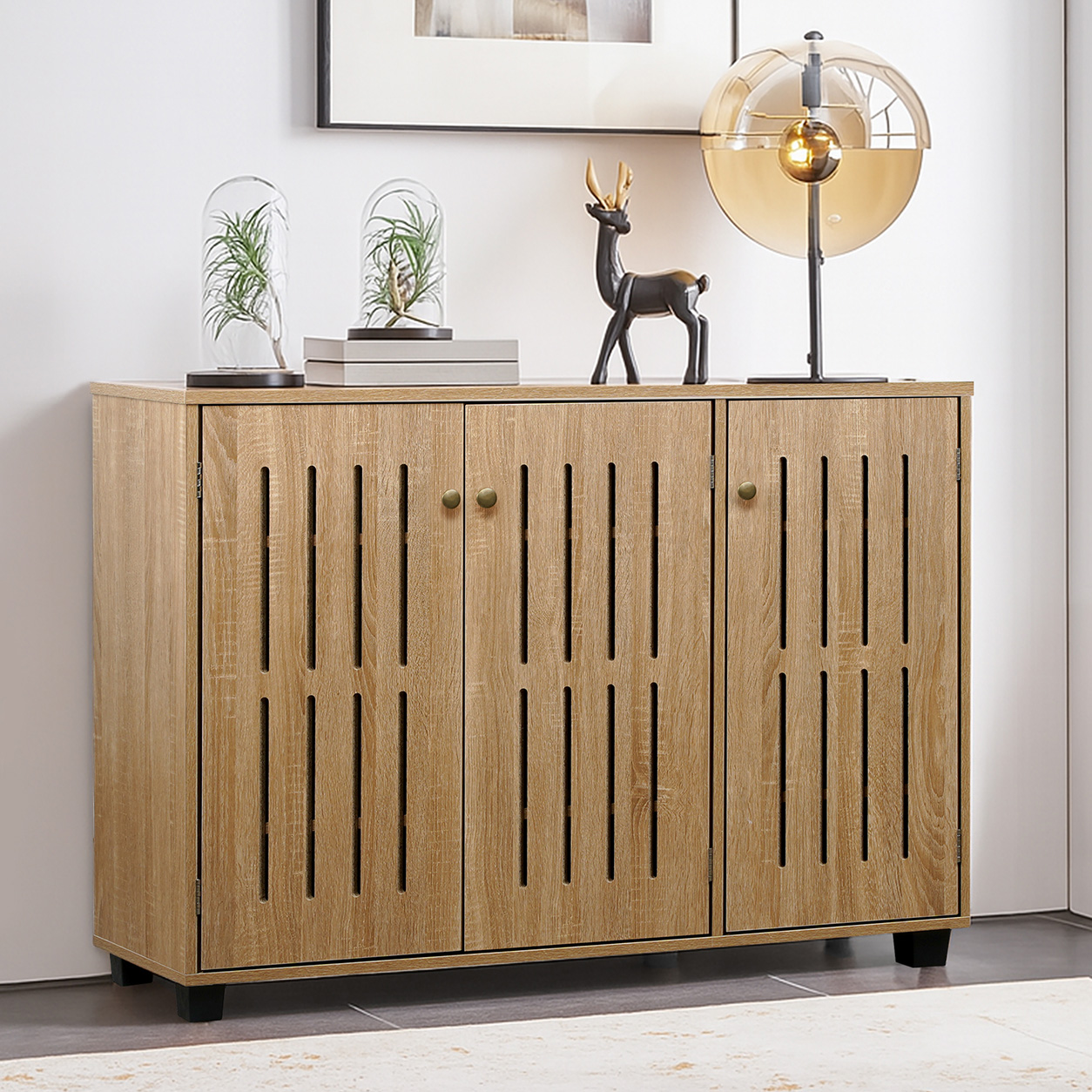
A closed cupboard hides shoes, but its appearance does not reveal how air moves through it. Check for actual ventilation openings rather than assuming that timber or metal makes the entire unit breathable, such as LivaraHome's ELLER shoe cabinet has slatted door designs blends seamlessly into any décor with its clean, timeless aesthetic.
If you regularly store wet footwear, use a separate drying area or removable tray to contain drips. Shoes should not be left to dry inside a closed cabinet where moisture can accumulate.
Leave enough room for any ventilation features to work as intended. Packing every compartment tightly may increase storage capacity on paper but make the arrangement less practical.
The aim is to manage moisture at its source. Choosing a different furniture material should not be the only response to an entrance that regularly stays damp.
Cleaning and maintenance
Think about the cleaning tasks you can realistically keep up with. Furniture with removable shelves and accessible corners may be easier to maintain than designs with narrow, enclosed recesses.
Check the manufacturer's care instructions before using cleaners, oils or polishes. A treatment intended for one finish may not be suitable for another.
For coated metal, follow the supplier's advice on cleaning deposits and dealing with surface damage. For timber and panel furniture, check how to care for scratches or chipped edges.
Access beneath the unit matters too. Open legs, a closed base or a design that can be moved according to the manufacturer's instructions will each affect how easily you can clean the floor.
Choosing Furniture for Different Household Needs
Rather than looking for one universally best material, narrow your options according to what the entrance needs to do. Then compare products that meet those requirements.
For a simple indoor landing spot
If the main purpose is holding keys, mail and a daily bag, start with a console table or compact cabinet. There is little value in choosing a large storage unit when a smaller surface can do the job.
For a smooth painted look, MDF is one option to explore. If visible grain is the priority, compare solid timber and veneered designs while checking what lies beneath the surface.
For a household with several pairs of daily shoes
Start with internal dimensions and storage layout. The right material will not compensate for shelves that are too shallow or compartments that do not suit your footwear.
A dedicated shoe cabinet may be more practical than a general-purpose sideboard. If sitting down to change shoes is important, consider a purpose-designed storage bench instead.
For a high-use entrance
Prioritise accessible storage, straightforward cleaning and clearly stated product specifications. These details help you assess whether the furniture is suited to repeated daily use.
Do not assume one material is always the strongest. Compare the actual shelf support, hardware and load limits of the products on your shortlist.
For damp or exposed positions
First establish whether the product is approved for the intended location. If that information is missing, ask the supplier rather than inferring suitability from descriptions such as "marine", "moisture-resistant" or "powder-coated".
If no suitable enclosed storage product meets the conditions, reconsider the placement. Moving the main cabinet further inside and keeping only a temporary drop zone near the door may be a more practical arrangement.
5. What to Check Before Buying
Use this checklist to compare product listings and ask more useful questions:
What are the body, doors, shelves and back panel made from?
Is the visible surface paint, veneer, laminate or solid timber?
Are relevant board grades or metal types identified?
Is the product approved for its intended indoor or outdoor position?
Are shelf and seat load limits stated separately where needed?
Will the internal layout fit the items you plan to store?
Are cleaning instructions and replacement-part details available?
Can the supplier provide evidence for specific performance claims?
For engineered boards, you can also ask about formaldehyde-emission information. Your Home recommends checking emission classes and recognising that adhesives and finishes contribute to the finished furniture's indoor-air profile.
Conclusion
Choosing entryway furniture is less about finding one "best" material and more about matching a well-specified product to its surroundings.
Start with the conditions at your door, then compare construction, surface protection and layout. This gives you a clearer basis for choosing furniture that works for your household, rather than simply selecting a piece that looks right in a photograph.