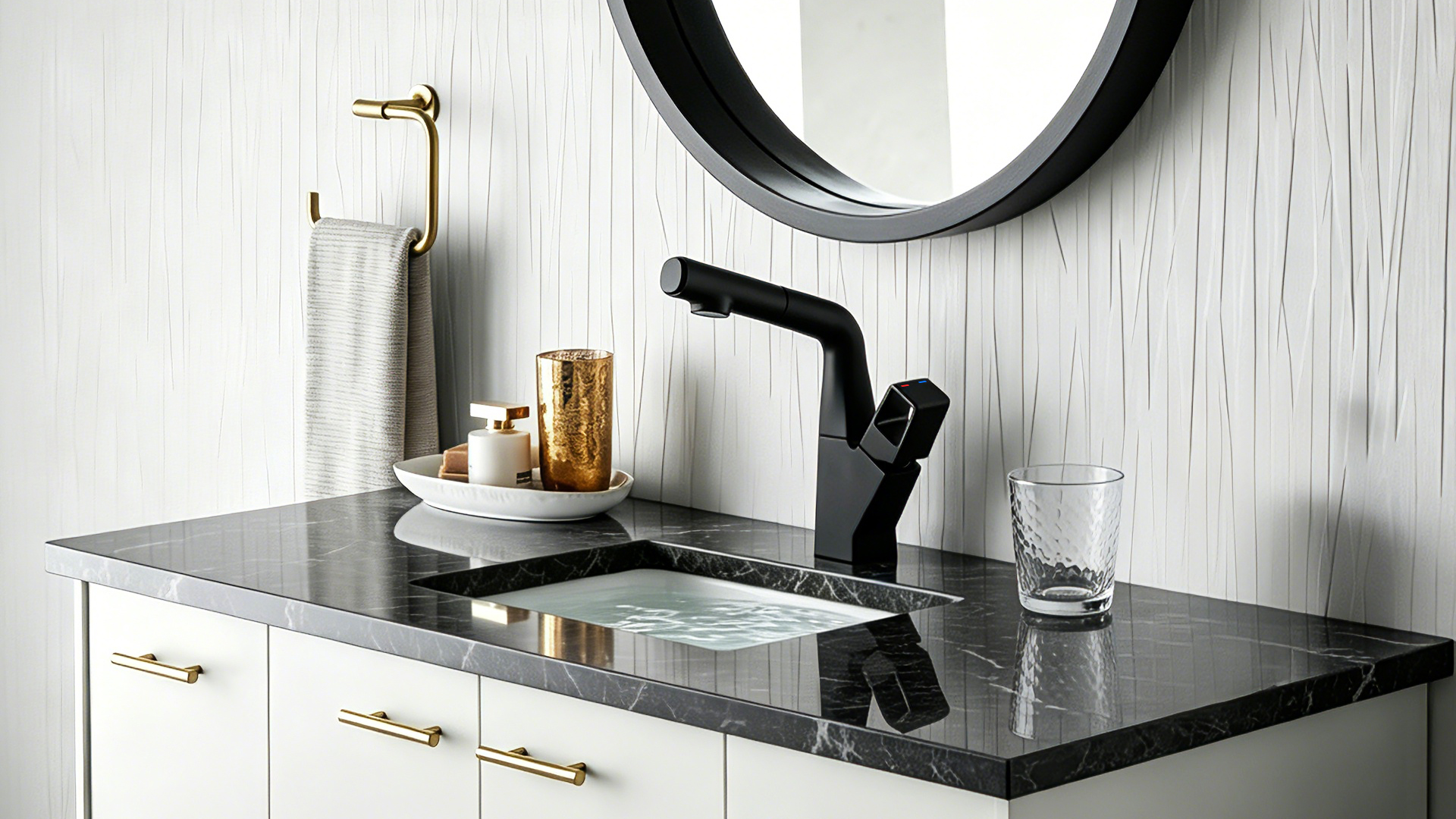
A mixer and a basin may be specified as two products, but in use they become one working relationship shaped by reach, height, bowl geometry and water movement.
A basin and a mixer are often selected separately.
The basin may be chosen first for its shape, material and proportion. Tapware might follow later, selected for finish, form or the wider language of the bathroom.
On a schedule, that separation makes sense.
In use, it becomes much less clear.
The moment water leaves the outlet, the basin and mixer begin to behave as one arrangement. Height affects clearance. Reach affects where the stream enters the bowl. Basin depth and internal geometry influence how that water is received. The position of the mixer changes how much of the bowl feels usable. Even cleaning access and handle movement are shaped by the relationship between the two.
This is why two individually well-designed products can still feel awkward when combined.
The interesting part is not whether either object is “good” or “bad”.
It is what happens between them.
Height Matters, but Relationship Matters More
Mixer height is useful to know.
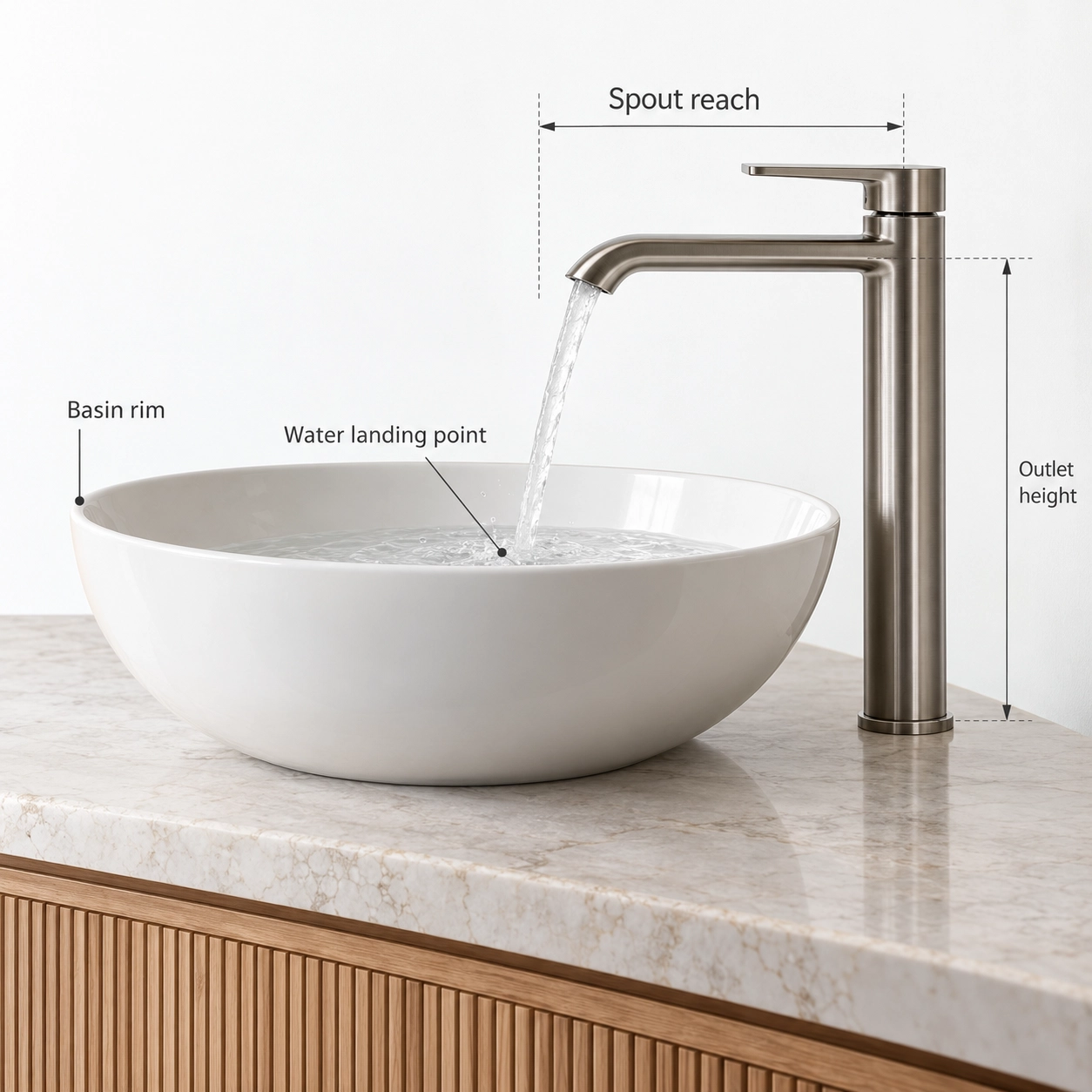
So is spout reach.
So is basin depth.
But each measurement only tells part of the story.
A tall mixer may still have a short reach. A basin may look generous from above but have a shallow internal bowl. A wall-mounted spout may project far enough from the wall, yet still deliver water into the wrong part of the basin once the final wall build-up and basin position are considered.
What becomes more useful is looking at the geometry as one whole.
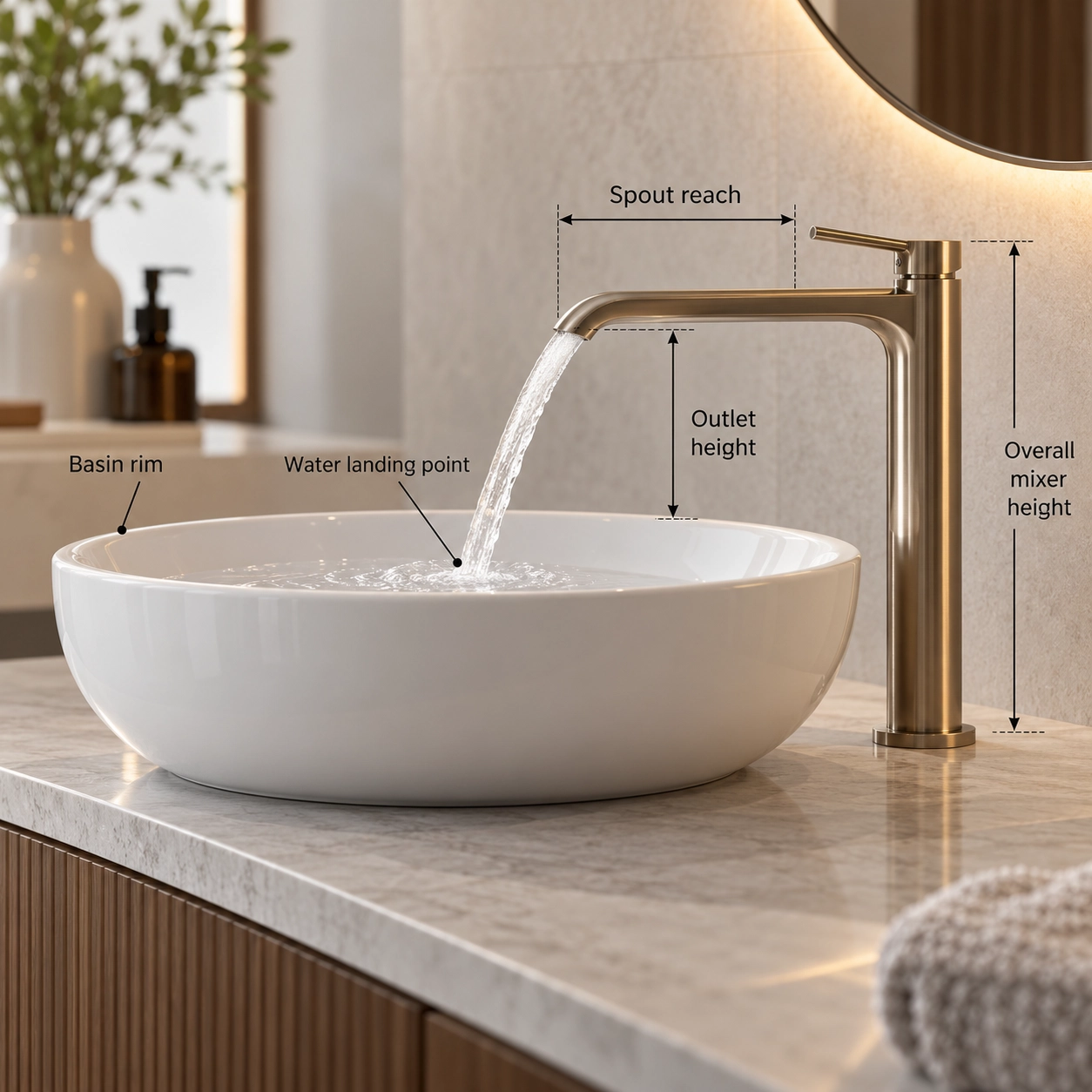
There is a point where the water leaves the mixer.
There is another point where that stream meets the basin.
The quality of the setup is often decided somewhere between those two points.
Water Landing Changes How the Basin Feels to Use
One of the most revealing questions is also one of the simplest:
Where does the water actually land?
If the stream falls very close to the rear of the bowl, handwashing can feel compressed. If it reaches too far forward, the user may end up working near the front edge of the basin. If it strikes a steep internal face, the bowl may redirect some of that energy outward.
This is where spout reach often becomes more important than it first appears.
The same relationship appears in kitchen planning, where spout height, reach and fixture position also influence how a sink performs in daily use.
A mixer can clear the basin rim comfortably and still feel wrong if the stream enters the bowl in an awkward place.
The most useful landing area is usually somewhere within the natural working zone of the basin: not so far back that the rear wall dominates the interaction, and not so far forward that the basin begins to feel shallow.
This does not need to be reduced to one universal number.
Different basins receive water differently.
Bowl Geometry Is Part of the Equation
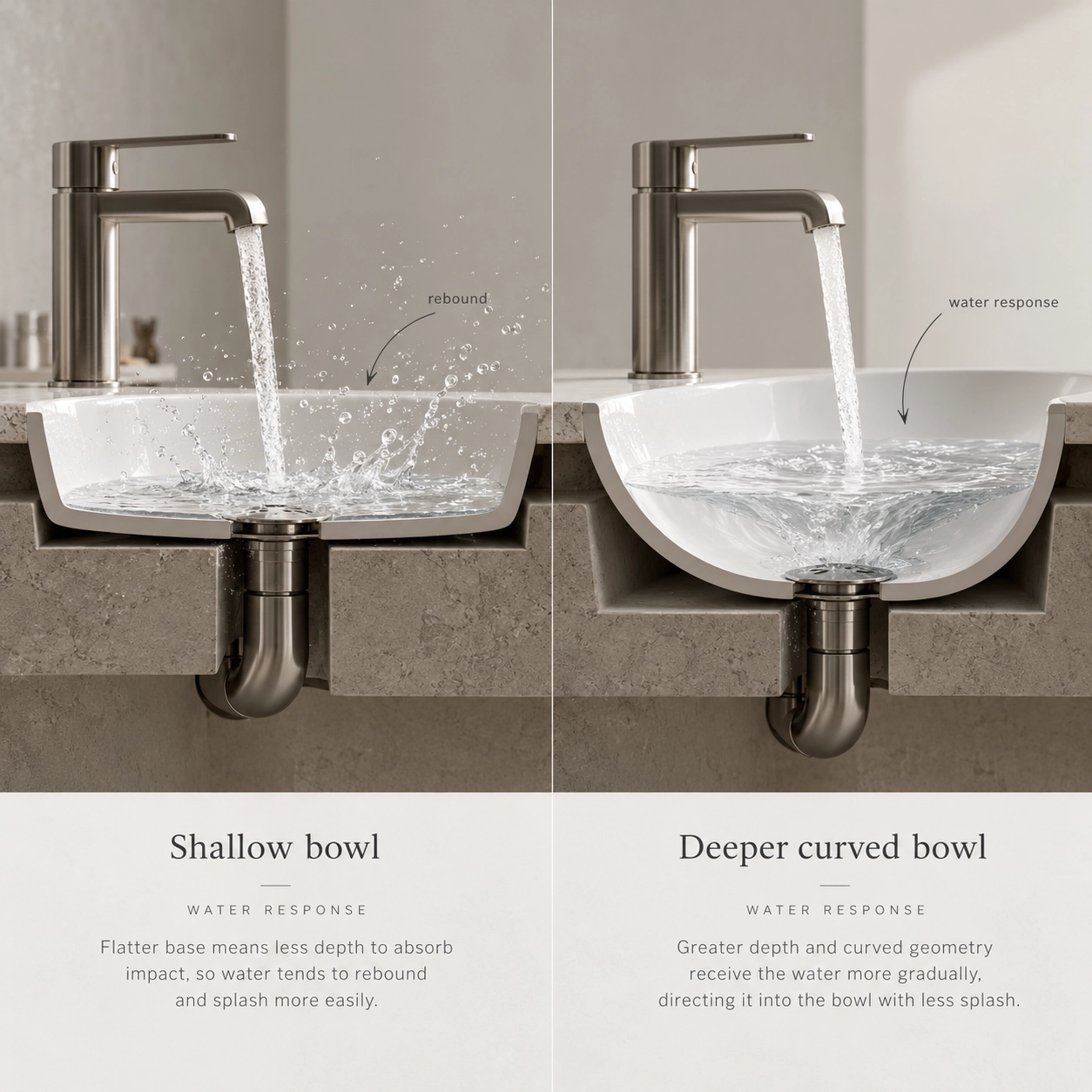
Two basins with the same external width can behave very differently.
A deep rounded bowl may guide water gradually toward the centre.
A shallow basin with a flatter base can respond more abruptly.
A bowl with steep internal walls may alter the direction of the stream again.
This is one reason a fixed rule such as “the water should hit the waste” is too crude to be universally useful.
The waste may be a helpful reference point, but the bowl itself matters more.
Its depth, curvature and internal slope all influence how water moves once it arrives.
The basin is not simply a container beneath the tap.
It is part of the hydraulic behaviour of the whole setup.
Above-Counter Basins Make the Relationship More Visible
Above-counter basins make this relationship especially easy to notice because the bowl rises above the vanity top.
The mixer needs enough height to clear the rim, but that is only the beginning.
A tall mixer with insufficient reach may still deliver water too close to the rear of the basin.
A mixer positioned very high over a shallow bowl may create more visible splash than expected.
A basin that projects far forward on a shallow vanity may leave little room behind it for a deck-mounted mixer.
This is where the phrase “tall basin mixer” can be misleading if it is treated as a complete solution.
Tall describes one dimension.
The basin still asks questions about reach, clearance and position.
The Mixer Can Change How Large the Basin Feels in Use
A basin can be generous in plan and still feel cramped.
That usually happens when the mixer occupies too much of the working space.
If the outlet finishes close to the rear wall, hands naturally move into the narrow zone between the spout and the back of the bowl.
The basin has not physically become smaller.
But the usable area has.
This is particularly noticeable in compact bathrooms, narrow ensuites and shallow vanity setups, where there is less tolerance for poor alignment.
It is one of those details that rarely appears clearly in product photography but becomes obvious in daily use.
Vanity Depth Quietly Shapes the Entire Arrangement
The basin-mixer relationship is also influenced by the vanity beneath it.
A shallow vanity can be extremely useful in a narrow room, but it creates a tighter front-to-back envelope.
The basin may occupy most of that depth.
That can leave limited room for a mixer base behind the bowl.
The result might be technically possible while still being awkward to clean, difficult to operate or visually compressed.
A deeper vanity creates more flexibility, but also occupies more circulation space in the room.
So vanity depth is not simply a cabinetry dimension.
It is part of the geometry that determines whether the basin and mixer can sit comfortably together.
Wall-Mounted Tapware Moves the Complexity Elsewhere
Wall-mounted mixers can create a very clean relationship with the vanity surface.
The benchtop remains visually quiet.
The mixer body disappears.
Cleaning around the basin may become easier.
But the apparent simplicity comes from moving the complexity into the wall.
The concealed body is installed earlier.
Finished wall thickness matters.
Tile build-up matters.
Spout projection matters.
And basin position matters.
Once the rough-in is fixed, later changes become less forgiving.
If the basin moves forward, the landing point moves with it.
If the finished wall becomes thicker than expected, the effective projection changes.
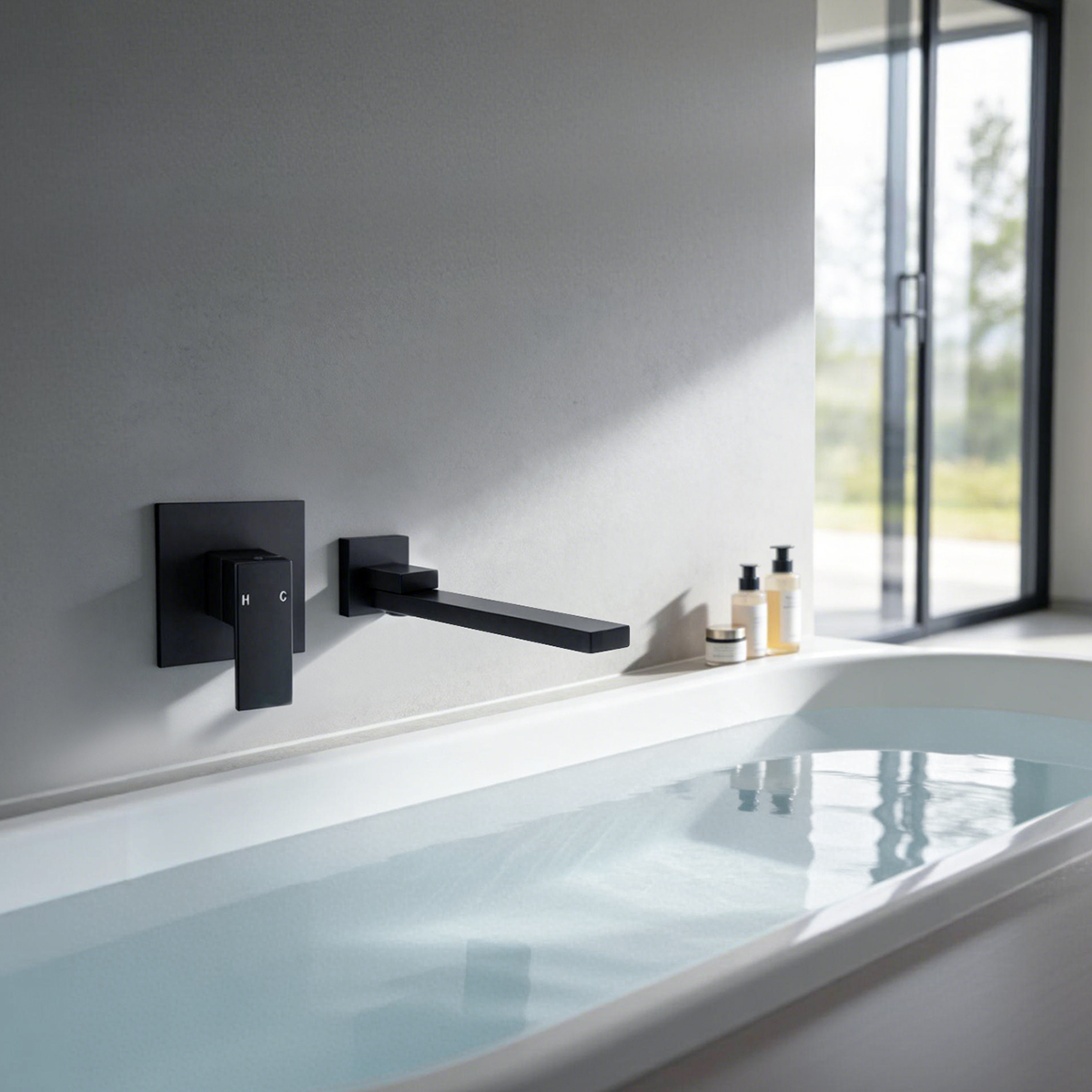
The final composition may look simple, but the coordination behind it is anything but casual.
Handle Movement Is Easy to Miss Until It Is Too Late
The water outlet receives most of the attention, but the control itself also needs space.
Some mixer handles move backward.
Others move upward or sideways.
If the mixer sits close to a wall, mirror, shelf or basin rim, that movement can become restricted.
This is another example of why product dimensions alone do not always describe the real experience.
The body may fit.
The spout may reach.
But the hand still needs somewhere to operate the control.
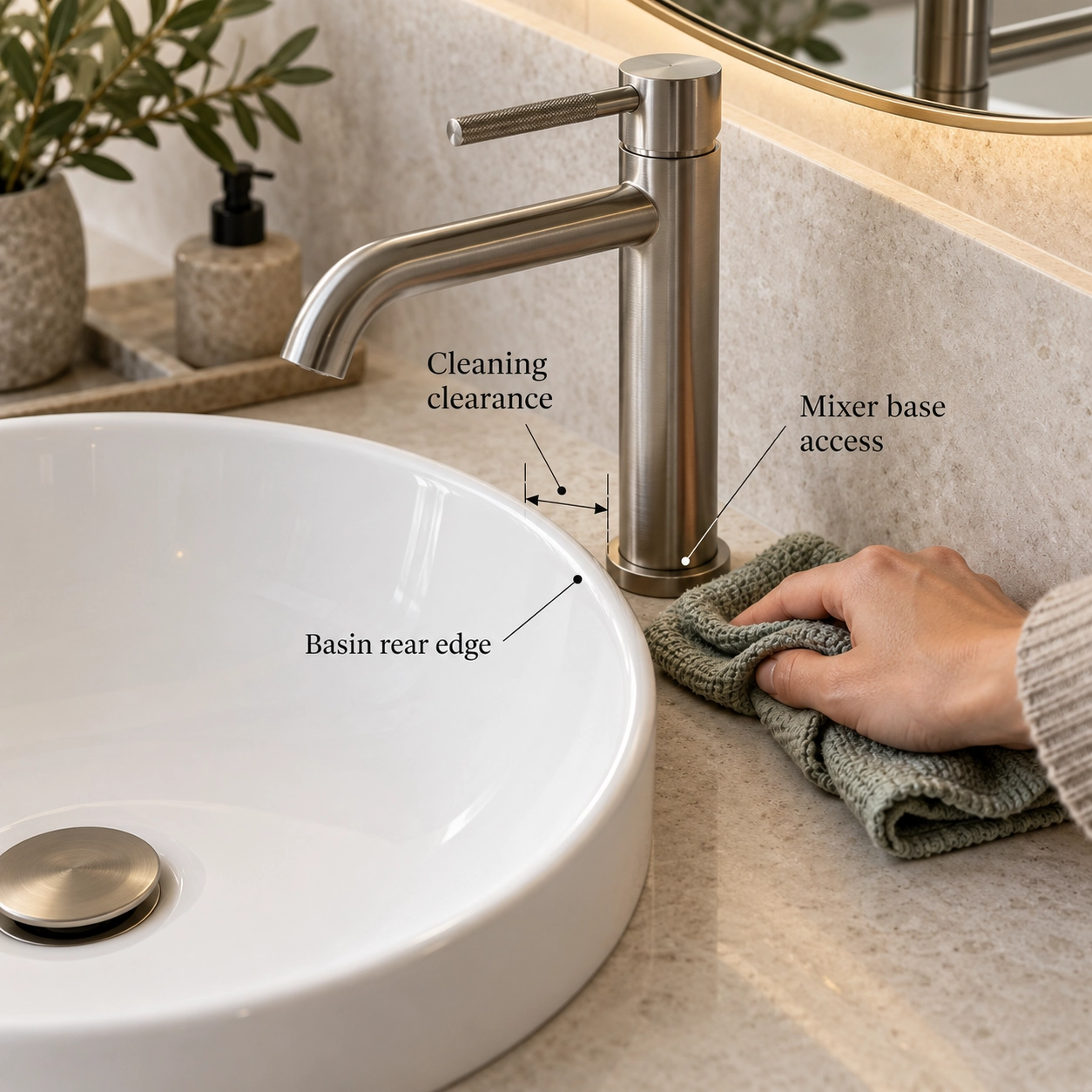
Cleaning Clearance Is Part of the Design
A very tight basin-mixer composition can look beautifully resolved in a photograph.
In daily use, the small gap behind the basin may become the most difficult part to maintain.
Water, soap, toothpaste and dust tend to collect around mixer bases and basin edges.
If there is barely enough room to fit a cloth between the two, the setup may begin to age poorly even if it looked precise on installation day.
This is not a question of making everything widely spaced.
It is simply another reminder that the space between objects has a function too.
The same principle applies elsewhere in a bathroom: the visible finish is only one part of how a surface or fitting performs once water, cleaning and daily use are introduced.
Water Pressure Changes the Same Geometry
The same basin and mixer combination can behave differently under different water conditions.
Flow rate and pressure affect how forcefully the stream reaches the bowl.
A high outlet over a shallow basin may feel calm at moderate flow and more aggressive at higher flow.
This is particularly relevant in New Zealand, where low-pressure hot-water systems are still found in existing homes alongside mains-pressure systems. Building Performance notes that pressure conditions can affect both flow and the range of tapware suited to a system.
The visual relationship between basin and mixer may be identical.
The experience of using it may not be.
That makes pressure compatibility part of the same conversation, even if it is less visible than height or reach.
Finished Basin Height Changes the Entire Composition
Above-counter basins also affect the final working height.
The user does not experience the vanity cabinet as a separate dimension.
They experience the top edge of the basin.
That height is created by the combination of:
floor + vanity + benchtop + basin
A deep vessel basin placed on a relatively tall vanity can make the finished setup feel unexpectedly high.
This has consequences for both comfort and tapware selection.
The basin may require a taller mixer.
The mixer may then sit higher above the bowl.
The water has farther to travel.
Again, one decision changes several others.
Products That Look Right Together Are Not Always Products That Work Together
This is one of the more useful distinctions in bathroom specification.
Visual compatibility and functional compatibility are not the same thing.
That distinction also appears at a larger scale in bathroom planning, where layout, moisture, installation and daily routines often matter more than how individual products appear in isolation.
A basin and mixer may share the same design language.
Their proportions may look balanced.
Their finishes may work beautifully together.
And yet the relationship may still fail in use.
The reverse can also be true.
A combination that looks understated on paper may feel exceptionally natural once installed because the reach, height and bowl geometry happen to align well.
The point is not that appearance is unimportant.
It is that appearance is only one layer of the relationship.
Showrooms Help, but They Do Not Reproduce Every Installation
Seeing a basin and mixer together in person is useful because it allows the relationship to be read as a whole.
But even a showroom has limits.
The vanity may be deeper than the one planned for a project.
The tap-hole position may differ.
The mixer may not be connected to water.
The final wall build-up may be different.
The basin may sit farther forward or farther back.
What a showroom does well is reveal the relationship.
What it cannot always do is reproduce the exact conditions of a future installation.
Four Questions That Reveal Most Pairing Problems
Before installation becomes difficult to change, four questions usually reveal whether the relationship is working as intended:
Does the spout comfortably clear the basin?
Does the stream enter the useful part of the bowl?
Can the handle move freely?
Can the space around the basin and mixer be cleaned without difficulty?
These are not rules.
They are simply useful ways of seeing the setup more clearly.
The Basin and Mixer Are Better Read as One Assembly
On schedules and product pages, the basin and mixer may appear as separate items.
That separation is useful for ordering.
It is less useful for understanding how the bathroom will feel in use.
The user experiences one composition.
Water leaves one object and immediately enters the geometry of the other.
The basin shapes the stream.
The mixer shapes the reach.
The vanity controls the available space.
The wall determines what can be concealed.
The pressure system affects how forcefully the water arrives.
None of these variables is especially complicated on its own.
What matters is how they meet.
And that small meeting point—between outlet, bowl, hand and water—is where much of the everyday quality of the setup is decided.